School Gate Attendance With UHF: Placement, Read Range Questions and What to Ask a Vendor
Last checked: 10 October 2026. By the My School Ride team. My School Ride is a product of Satcop India Pvt. Ltd.
Between 7:30 and 8:00 am, a school gate can see hundreds of students arrive by bus, van, car, scooter and on foot. Taking accurate attendance in that rush, without a queue, is hard by hand. A UHF school gate attendance system reads a tag as each student walks through, records entry time, and can alert parents that their child reached school.
This guide covers how to plan a UHF gate system well: where to put readers, what "read range" really means, how to test, and what to ask a vendor. Our product page is UHF attendance system.
How UHF gate attendance works
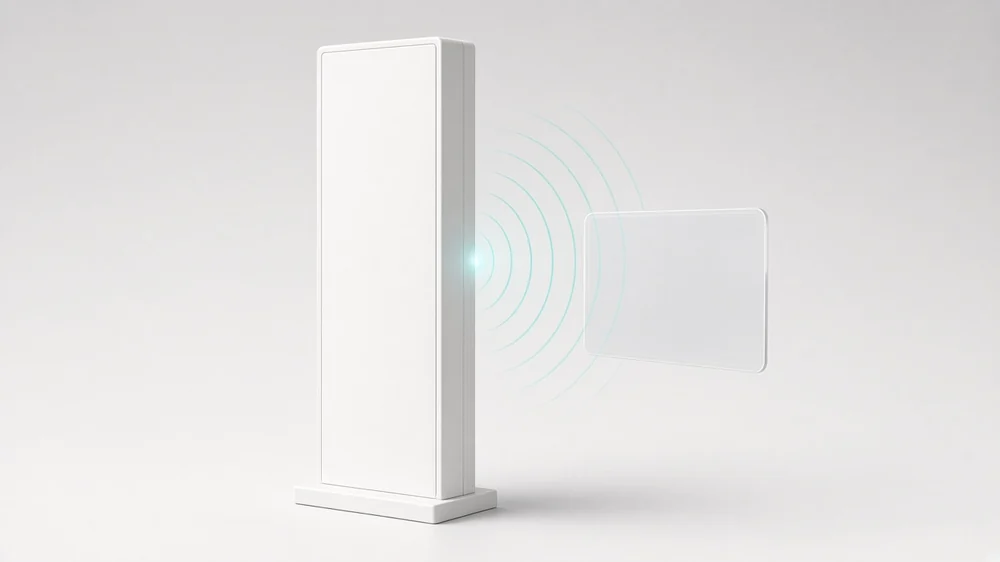
Each student carries a UHF tag, usually in an ID card. Readers with antennas are mounted at the gate. When a student passes through the read zone, the reader picks up the tag and records the time. No tapping is needed, so students keep walking.
Compared with RFID tap cards, which suit the bus where students board one at a time, UHF suits wide, busy entrances. My School Ride explains the difference in RFID vs UHF at the school gate.
Planning step 1: Map your entrances
- List every entrance students use, including side gates and bus bays.
- Note peak times and roughly how students arrive (by bus, on foot, dropped off).
- Decide whether all students must use specific gates. Fewer entrances means fewer readers and more complete records.
Planning step 2: Placement
Good placement matters more than any specification sheet.
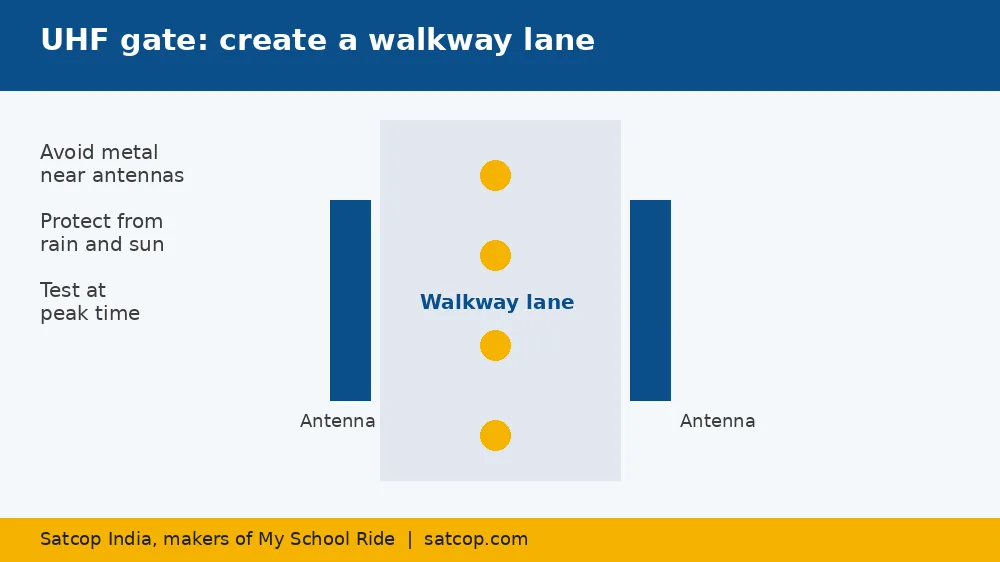
- Create a natural lane. Readers work best when students pass through a defined walkway, not a wide open space.
- Mount antennas at a suitable height and angle, facing the walkway, as your vendor advises for your tag type.
- Avoid metal and interference close to antennas where possible, such as large metal gates swinging through the read zone.
- Protect equipment from rain and direct sun, especially in monsoon cities like Mumbai, Kolkata and Kochi.
- Plan power and network at the gate before installation day.
Planning step 3: Ask about read range the right way
"Read range" sounds like one number, but in practice it depends on the reader, antenna, tag, how the tag is carried (in a bag, on a lanyard, in a pocket), the body of the person carrying it, and the surroundings. A figure quoted in ideal conditions may not match your gate.
Instead of asking "what is the read range?", ask:
- Will it reliably read every tag when students walk through our gate in a group at normal speed?
- Does it work when the card is in a bag or under a sweater?
- Can you test at our gate, at peak time, before we buy?
A site test answers these better than any brochure.
Planning step 4: Tags and cards
- Choose a tag format students will actually carry every day, usually the school ID card.
- Decide what happens with lost tags: same-day blocking and replacement.
- Consider whether the same card can serve bus RFID and gate UHF, to keep it simple for students.
Planning step 5: Alerts and records
Decide who receives what:
- Parents: a "reached school" alert, if the school chooses.
- Class teachers: a list of students not recorded at the gate by a set time.
- Admin office: gate exceptions, such as a student who boarded the bus but was not read at the gate.
Matching gate records with RFID bus attendance is where the biggest safety value lies.
Planning step 6: Test at peak time
Before go-live:
- Run the system for a week alongside manual attendance.
- Compare the two lists daily and investigate every mismatch.
- Adjust antenna position and lane layout until results match.
Questions to ask a vendor
- Can you do a site survey and peak-time test at our gate?
- How many readers and antennas do we need for our entrances?
- How are tags issued, replaced and blocked?
- Can gate records be matched with bus attendance?
- Which alerts can parents and staff receive?
- How is the equipment protected outdoors?
- What support do you offer if a reader fails?
- What is included in the quote: readers, antennas, tags, installation, software and support?
Common mistakes
- Placing readers at a wide-open gate with no defined lane.
- Buying based on a brochure read range without a site test.
- Forgetting side gates students actually use.
- Not planning for lost or forgotten tags.
Across cities
Large campuses in Pune, Bengaluru, Hyderabad, Gurugram and Noida often have several gates and benefit from lane design. In Mumbai, Kolkata and Chennai, weather protection matters. Satcop India's head office is in Pune (Kharadi) and we have an office in Hyderabad (Gachibowli); in other cities, including Delhi, Ahmedabad, Jaipur and Lucknow, we serve schools and demo on your campus.
Where we fit
Our UHF attendance system works with RFID bus attendance, our school bus tracking solution and the My School Ride app, used by 200+ schools, 10,000+ buses and 200,000+ students.
Frequently asked questions
What is a school gate attendance system?
A system that records when each student enters and leaves campus, often using UHF tags read automatically at the gate.
What read range does a UHF gate reader have?
It depends on the reader, antenna, tag and how students carry it. Ask for a test at your own gate at peak time rather than relying on a brochure number.
Do students need to stop and tap at a UHF gate?
No. Tags are read as students walk through the read zone.
Can gate attendance link with school bus attendance?
Yes. Matching the two flags students who boarded the bus but were not recorded at the gate.
How much does a UHF gate attendance system cost?
It depends on the number of gates and students. Ask for a quote.
Explore My School Ride
Book a demo
Tell us your city and how many buses you run. Book a demo · Ask for a quote · Chat with us on WhatsApp (+91 91560 88090) · Call +91 8600 002222
Sources
- satcop.com UHF page; MSR RFID vs UHF page (read 10 Oct 2026). No read-range numbers.