Missed Taps, Lost Cards and Substitute Buses: Fixing Real-World RFID Attendance Problems
Last checked: 10 October 2026. By the My School Ride team. My School Ride is a product of Satcop India Pvt. Ltd.
RFID attendance on the school bus works beautifully in a demo: a child taps a card, a beep sounds, and the parent's phone shows "boarded". On a real Monday morning, things are messier. A child forgets the card. A bus breaks down and students move to a substitute. A younger student taps twice. A reader stops working after a bumpy route.
None of these problems mean RFID does not work. They mean the school needs a routine for the exceptions. This post covers the most common issues and practical fixes. It is based on how schools actually run RFID attendance systems day to day.
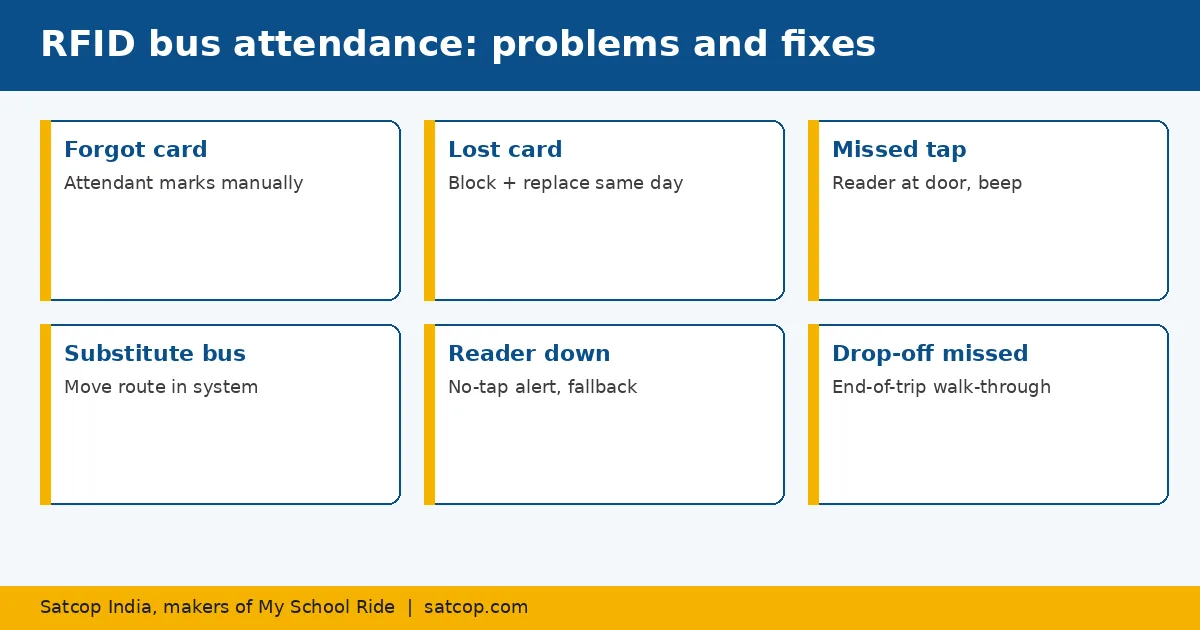
Problem 1: The student forgot the card
What happens: no boarding record, and the parent gets no alert, or worse, worries when the alert does not arrive.
Fixes:
- Give the attendant a manual "mark boarded" option in their app, so the record and parent alert still happen.
- Keep a short list of students who forget often, and send a gentle reminder to parents.
- Attach cards to the school bag or ID lanyard so they travel with the child.
Problem 2: The card is lost or damaged
What happens: repeated manual marking, and the risk that someone else uses the card.
Fixes:
- Block the lost card in the system the same day.
- Issue a replacement quickly, with a simple request process through the class teacher or office.
- Keep a small stock of spare cards at the transport office.
Problem 3: Missed taps in a rush
What happens: at busy stops, several students board at once and one slips past without tapping.
Fixes:
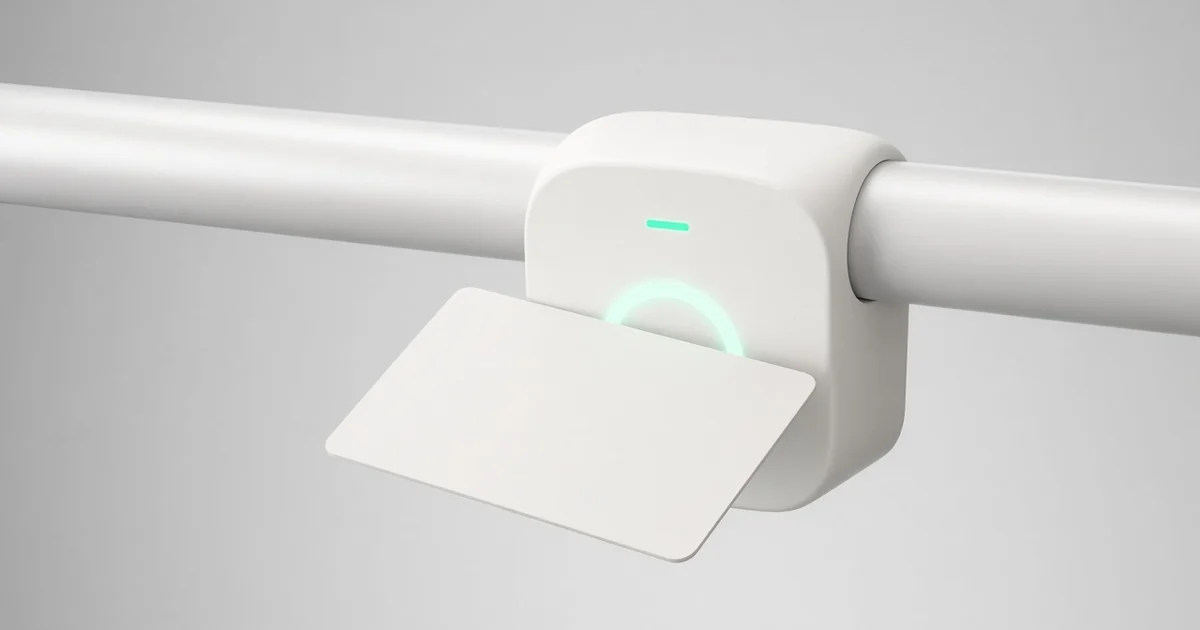
- Fit the reader right at the door, at a height every child can reach.
- Ask the attendant to stand by the reader at boarding.
- Use a clear audible beep so students know the tap worked.
- Review missed taps weekly: if the same stop causes trouble, change the boarding routine there.
Problem 4: Double taps and wrong-bus taps
What happens: a child taps twice, or taps on a sibling's bus by mistake.
Fixes:
- Systems usually ignore repeated taps within a short window; check this with your vendor.
- Link each card to an assigned bus and flag taps on a different bus for the office to review.
Problem 5: Substitute bus on the day
What happens: a bus breaks down, and students move to another bus whose reader does not expect them.
Fixes:
- Allow the transport office to temporarily move a route's students to another bus in the system.
- If that is not possible in time, the attendant marks students manually and the office corrects records later.
- Tell parents through the app that a substitute bus is running, so they are not confused by the bus number on the map.
Problem 6: Reader not working
What happens: no taps register on that bus.
Fixes:
- Set an alert so the office knows when a bus has had no taps on a trip that normally has many.
- Check power and wiring first; vibration on rough roads can loosen connections.
- Fall back to manual marking until the reader is fixed, and log the fault with the vendor.
Problem 7: Drop-off tap missed
What happens: the parent gets a boarding alert but no drop-off alert, and calls the school.
Fixes:
- Remind attendants that drop-off taps matter as much as boarding.
- At the end of every trip, the attendant walks the bus to check no child is left on board, regardless of tap records.
- Show parents in the app when a drop-off was marked manually, so they know the child was handed over.
Problem 8: Students using someone else's card
What happens: attendance records do not match who actually boarded.
Fixes:
- Attendants know their regular students; ask them to watch for unfamiliar faces.
- Print student name and photo on the card where possible.
- Compare bus records with gate attendance from a UHF gate system to spot mismatches.
A weekly RFID health check
Every week, the transport office reviews:
- buses with unusually low tap counts;
- students with repeated manual marks;
- lost card requests;
- reader faults and repairs.
This takes 15 minutes and keeps the system trusted.
Training makes the difference
Most problems shrink with good training. A short briefing at the start of each term should cover: where the reader is, how to mark manually, how to report a fault, and why the end-of-trip walk-through matters. Include contractor attendants, who may change during the year.
Across cities
The same fixes apply whether your school is in Pune, Mumbai, Delhi NCR, Bengaluru, Hyderabad, Chennai, Kolkata or Ahmedabad. Schools on longer, bumpier routes should check readers and wiring more often. Satcop India's head office is in Pune (Kharadi) and we have an office in Hyderabad (Gachibowli); in other cities we serve schools and demo on your campus.
Where we fit
Our RFID attendance works with our school bus tracking solution and the My School Ride app, used by 200+ schools, 10,000+ buses and 200,000+ students. For how the cards work, see My School Ride's RFID attendance page.
Frequently asked questions
What if a student forgets the RFID card on the school bus?
The attendant marks the student manually in the app, so the record and parent alert still happen.
What happens when an RFID card is lost?
Block it in the system the same day and issue a replacement.
Can RFID attendance work on a substitute bus?
Yes, if the office moves the route's students to the substitute bus in the system, or the attendant marks them manually.
How do we know if a bus RFID reader has stopped working?
Set an alert for trips with no taps, and review tap counts weekly.
How much does RFID bus attendance cost?
It depends on the number of buses and students. Ask for a quote.
Explore My School Ride
Book a demo
Tell us your city and how many buses you run. Book a demo · Ask for a quote · Chat with us on WhatsApp (+91 91560 88090) · Call +91 8600 002222
Sources
- satcop.com RFID page FAQs (read 10 Oct 2026). Vendor features to confirm (double-tap window, temporary bus reassignment) are phrased as "check with your vendor".