School Bus Safety Checklist for Indian Schools
Last checked: 5 October 2026. By the My School Ride team. My School Ride is a product of Satcop India Pvt. Ltd, so read with that in mind. This is a plain-words checklist, not legal advice.
A school bus carries the most precious passengers a school has. Most safety problems are small things that nobody checked: a missing attendance list, an unverified driver, a fire extinguisher past its date, a parent who could not reach anyone. This checklist puts those small things in one place. Print it, go through it once a term, and give each item an owner.
Rules for school buses differ from state to state. Where we mention a rule, we quote one example: the Maharashtra Gazette of 16 July 2026, which amends the Maharashtra school bus rules. Ask your RTO or state transport department what applies to your school.
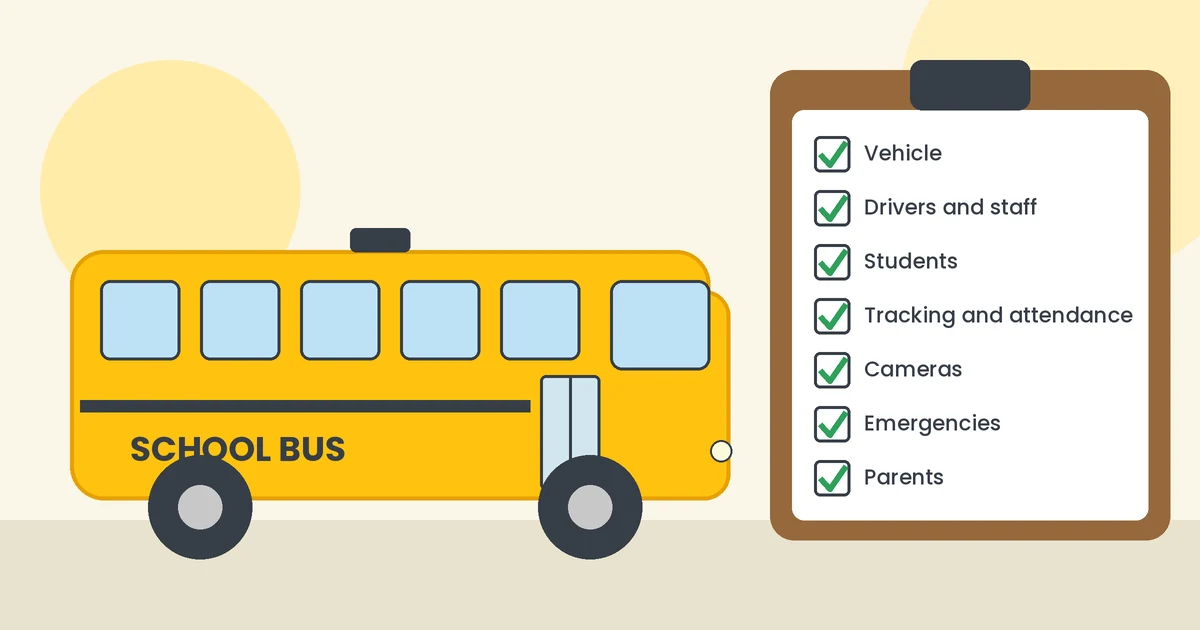
1. The vehicle
- The permit, fitness certificate and insurance of every bus and van are valid, and copies are kept in the school office.
- Every seat has a seat belt that works. The Gazette says seat belts are to be provided for all seats.
- Fire safety equipment is fitted and in date. The Gazette says a fire detection and alarm system (AIS-135), or a 1 kg ABC-class fireball in the engine compartment and near the emergency exit, is to be fitted.
- The emergency exit opens easily and is never blocked by bags.
- The bus does not carry more children than its seats.
- Hired and contract buses are checked the same way as your own buses.
2. Drivers, attendants and staff
- Every driver and attendant has a written appointment letter.
- Background verification and medical fitness are done and recorded. The Gazette says drivers, lady attendants and other transport staff are to be appointed in writing after background verification and medical fitness certification, with records shown to RTOs and police on demand.
- A lady attendant or another designated staff member is on every trip with young children. The Gazette says this applies to trips with students up to Standard 5.
- Drivers and attendants know what to do in an emergency, and who to call.
- Staff have been told how the tracking and attendance apps work.
3. Students
- There is a daily record of every student who boards and gets off, with times. The Gazette says a daily attendance record is to be kept, with the time of boarding and de-boarding.
- Every child is dropped only at the agreed stop, or handed over as the school decides.
- Children with disabilities or special needs have the support they need. The Gazette says appropriate support, including a trained attendant and accessibility features, is to be provided.
- Children know the basic bus rules: stay seated, belt on, no hands outside the window.
4. Tracking and attendance
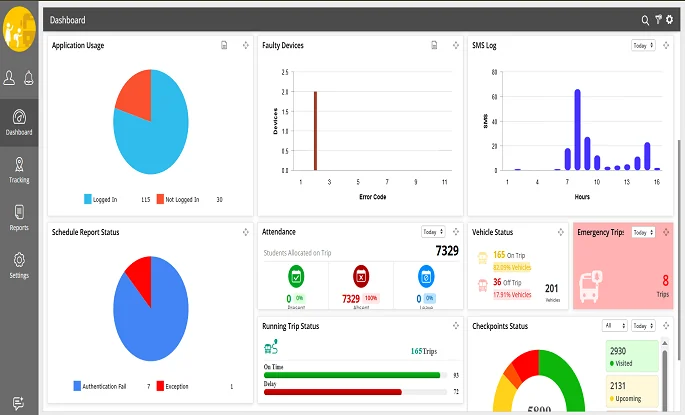
- Every bus has a GPS device, so the school and parents can see where it is. With My School Ride, a 4G GPS device sends the bus location about every 5 seconds, as the Satcop India website describes it.
- Students are counted on and off the bus. With My School Ride, students tap an RFID card on a reader on the bus handrail; see RFID attendance for school buses.
- You know what device is on each bus. The Gazette says the vehicle location tracking device is to conform to specifications not inferior to AIS-140 (rule 10(xxix)(a)). Satcop's AIS-140 device is described on its website as "Designed to meet AIS 140 standards as laid down by ARAI, physically tested by ICAT for 60 days — with GPS, GLONASS, and IRNSS (GAGAN) support." See AIS-140 for school buses.
5. Cameras
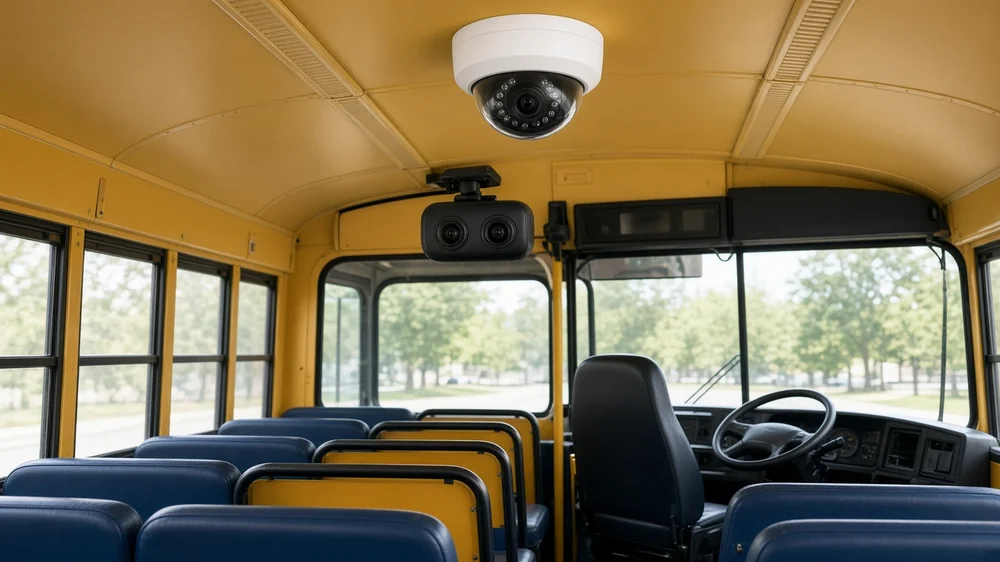
- You know which cameras are on each bus: road-facing dashcam, cabin camera or both.
- You know where footage is kept and who can see it.
- The Gazette says the Digital Safety Monitoring System is to include CCTV or video surveillance, with a feed to parents through a mobile app (rule 10A). It does not say whether a dashcam counts. Ask your RTO.
My School Ride offers optional 4G cameras and dashcams; see school bus dashcam and cameras.
6. Emergencies
- Every bus carries a list of emergency phone numbers: the school, the transport manager and the parents' contact list.
- Staff know how to raise an alert. The Satcop India website says its AIS-140 device has "Safety I/O" with SOS/panic inputs, and the My School Ride driver app has an SOS to the school admin. See our panic button guide for how these work.
- The school has a written plan for a breakdown, an accident and a lost child, and staff have practised it.
7. Parents
- Parents can see where the bus is without calling the driver. The My School Ride parent app shows a live bus map and alerts about 2 km before the stop.
- Parents know who to call if the bus is late.
- The school transport committee, if your school has one, hears parents' complaints and keeps notes.
How to use this checklist
Give each section an owner: the transport manager for the vehicle and staff, a class teacher or coordinator for students, the office for parents. Check it at the start of each term and after any change of bus, driver or contractor. Keep the filled-in copy with your transport records.
Where My School Ride fits
My School Ride helps with the tracking, attendance, camera and parent sections of this checklist. It does not replace a driver check, a fire extinguisher or a trained attendant, and we do not say any set-up meets a state rule by itself. Trusted by 200+ schools.
Frequently asked questions
What are the safety rules for school buses in India?
Rules differ by state. As one example, the Maharashtra Gazette of 16 July 2026 says school buses are to have seat belts for all seats, fire safety equipment, a vehicle location tracking device not inferior to AIS-140, a Digital Safety Monitoring System with CCTV and a parent app, a daily attendance record, and staff appointed after background and medical checks. This is what the Gazette text says, not legal advice. Ask your RTO what applies to you.
Does a school bus need CCTV?
CCTV shows what happens inside the bus and helps after an incident. The Maharashtra Gazette says the Digital Safety Monitoring System is to include CCTV or video surveillance, with a feed to parents through a mobile app. Rules in other states may differ, so ask your RTO.
Does a school bus need GPS?
GPS lets the school and parents see where the bus is, so fewer calls go to the driver. The Maharashtra Gazette says a vehicle location tracking device not inferior to AIS-140 is to be installed. Ask your RTO what applies to your state.
Does a school bus need a panic button?
A panic or SOS button lets staff raise an alert quickly. The Satcop India website lists SOS/panic inputs on its AIS-140 device and an SOS to admin in the driver app. We make no statement here about whether one is required; read the Gazette text and ask your RTO. See our panic button guide.
How often should a school check its buses?
At least once a term, and every time a bus, driver or contractor changes.
Book a demo
Tell us your city and how many buses you run. Book a demo · Chat with us on WhatsApp · Call +91 8600 002222
Sources
- Maharashtra Government Gazette, Extraordinary, Part IV-A, No. 309, 16 July 2026: rules 6B, 6C, 6D, 10(xxix) and 10A. Official PDF (read in full, 3 Oct 2026)
- satcop.com school bus page (My School Ride): GPS device, RFID reader, parent app, optional cameras, driver app SOS to admin. satcop.com/school-bus-tracking-solution/ (fetched 4 Oct 2026)
- satcop.com AIS-140 page: the AIS-140 sentence and "Safety I/O". satcop.com/ais-140irnss/ (fetched 4 Oct 2026)