Student Attendance on the School Bus: How RFID Cards Work
Last checked: 5 October 2026. By the My School Ride team. My School Ride is a product of Satcop India Pvt. Ltd, so read with that in mind. We show where each fact comes from.
On many school buses, attendance still means an attendant with a paper list, ticking names in a moving bus. Names get missed, lists get lost, and when a parent calls to ask "did my child get on?", nobody can answer quickly. RFID attendance replaces the paper list with a card and a reader. This post explains how it works, step by step, in plain words.
What is RFID?
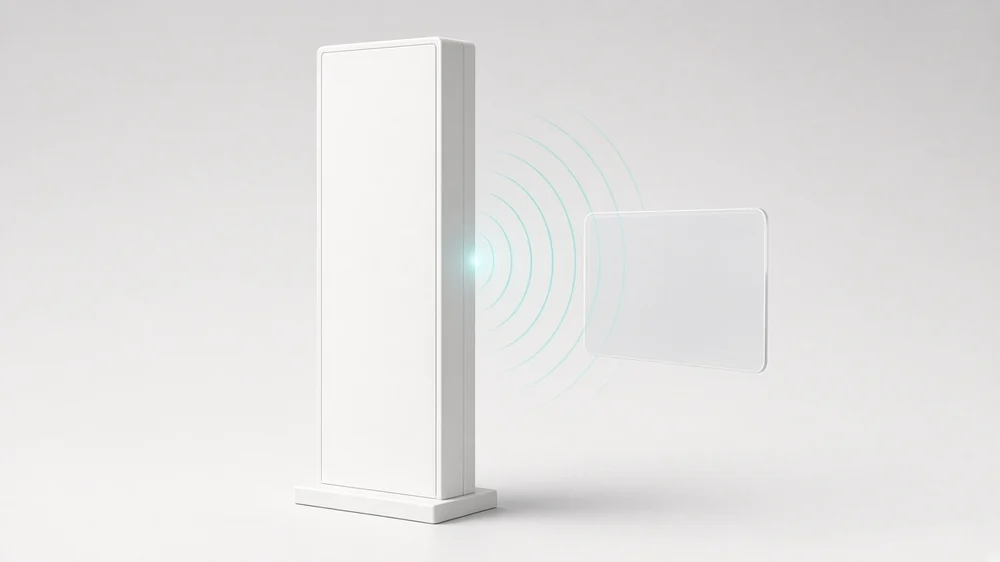
RFID stands for radio-frequency identification. A small chip and antenna sit inside a card. When the card comes close to a reader, the reader picks up the card's number by radio. There is no battery in the card and nothing to charge. Many schools build the RFID chip into the student ID card, so the child carries nothing extra.
How it works on the bus, step by step
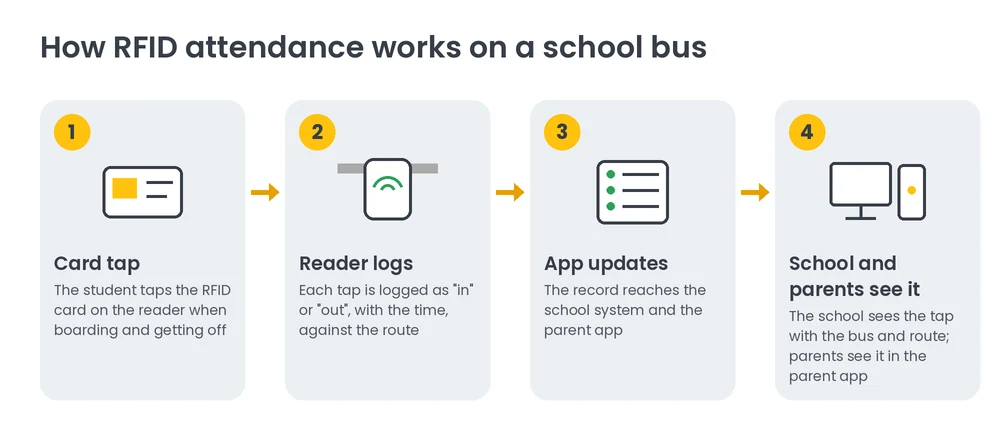
- The card. Each student gets an RFID card, often the school ID card itself.
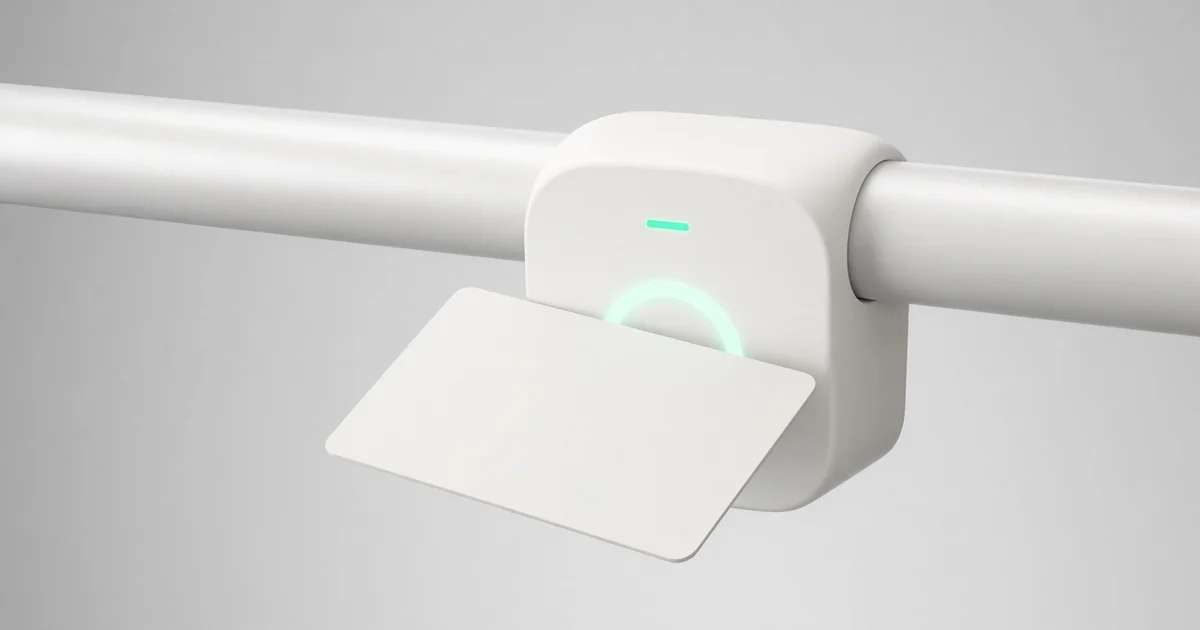
- The reader. A card reader is fixed to the bus. The Satcop India website describes a handrail-mounted card reader on the My School Ride bus.
- The tap. The student taps the card on the reader when boarding and again when getting off.
- The record. Each tap is logged against the route, as "in" or "out", with the time.
- The view. The record reaches the school system and the parent app.
Because the bus also has a GPS device, the school can see not just that a child tapped, but on which bus and route.
Who sees what
As described on the Satcop India website for My School Ride:
| Person | What they see |
|---|---|
| Parents | An attendance view in the parent app, plus pickup and drop reminders. SMS or app alerts where the school enables them (terms may apply) |
| Driver or attendant | The list of assigned students, an in and out report, and an attendant attendance mark in the driver app |
| Transport manager | RFID attendance on the central live dashboard |
| School admin | Reports by class, grade or date, ready for school systems |
What changes for the school
- No paper register to fill in on the bus.
- A live view of who is on the bus and who is not.
- Reports that are generated for you, instead of typed up later.
- Fewer phone calls from worried parents, because they can check the app.
An RFID reader records card taps. It does not supervise children, and it does not replace the bus attendant.
RFID on the bus, UHF at the gate
RFID cards need a tap, one child at a time. That works well at a bus door, where children board one by one. At a busy school gate, a queue of children each stopping to tap can slow the morning down. That is where UHF comes in. With UHF, the child carries a tag and a reader at the gate or classroom detects it as the child walks past, with no tap.
My School Ride uses RFID cards on the bus and offers UHF readers at school gates or classrooms. Read more on UHF attendance for schools and RFID vs UHF at the school gate.
What the Gazette says about bus attendance
Rules differ by state. As one example, the Maharashtra Gazette of 16 July 2026 says a daily attendance record of every student is to be kept, with the time of boarding and de-boarding (rule 6C). It also lists digital attendance as a feature of the app in the Digital Safety Monitoring System (rule 10A). This is what the Gazette text says, not legal advice. We do not say any attendance set-up meets a rule by itself. Ask your RTO what applies to your school.
Questions to ask before you buy
- Will the school's existing ID card work, or is a new card needed?
- Where will readers go: on the bus only, or also at the gate or classroom?
- How is a forgotten card handled on the day?
- What does a parent see, and is there a charge for alerts?
- In which reports does attendance reach the school's own software?
- Who may open student records, and how is access controlled?
- Does the quote list cards, readers, installation, support and GST?
Where My School Ride fits
My School Ride puts the RFID reader, the GPS device and the apps in one system, so the school sees bus location and attendance in one place. Trusted by 200+ schools. See RFID attendance for school buses for the product details. Price: Ask for a quote.
Frequently asked questions
How does RFID attendance work in a school bus?
A card reader is fixed on the bus handrail. Students tap their ID or RFID card when they board and when they get off. Each tap is logged against the route and reaches the school system and the parent app.
What is a school bus attendance system?
It is a way to record which students board and leave the bus, without a paper list. With RFID, each student taps a card on a reader in the bus.
How can a school monitor bus attendance in real time?
With My School Ride, the transport manager sees RFID attendance on a central live dashboard, and the school admin gets reports by class, grade or date.
What if a child forgets the card?
Our product pages do not state how this is handled. Ask us at the demo, and ask any other seller the same question.
Do parents get an alert when the child taps?
Parents see an attendance view in the parent app. SMS or app alerts are sent where the school enables them, and terms may apply.
How much does RFID attendance cost?
Ask for a quote. A good quote lists the cards, readers, installation, support and GST.
Book a demo
Tell us your city and how many buses you run. Book a demo · Chat with us on WhatsApp · Call +91 8600 002222
Sources
- satcop.com school bus page (My School Ride): handrail card reader, in and out logged against the route, apps, UHF at gates or classrooms. satcop.com/school-bus-tracking-solution/ (fetched 4 Oct 2026)
- satcop.com RFID attendance page: who sees what, the forgotten-card answer, questions to ask. satcop.com/rfid-attendance-system-school/ (fetched 4 Oct 2026)
- satcop.com Smart Attendance page: RFID and UHF cards, real-time view, reports by class, grade or date. satcop.com/smart-attendance-solution/ (fetched 4 Oct 2026)
- Maharashtra Government Gazette, Extraordinary, Part IV-A, No. 309, 16 July 2026: rules 6C and 10A. Official PDF (read in full, 3 Oct 2026)